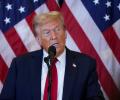
President Donald Trump on Tuesday claimed that BRICS was established to "hurt" the US and "degenerate" the dollar as he warned that the member countries of the bloc would face a 10 per cent tariff. Trump made the remarks while talking to reporters at the sixth Cabinet meeting at the White House.

India supports dialogue and diplomacy and not war, Prime Minister Narendra Modi said at the Brazil, Russia, India, China, South Africa (BRICS) Summit in Kazan, Russia on Wednesday, in an unambiguous message calling for resolution of the Russia-Ukraine conflict through peaceful negotiations.

Prime Minister Manmohan Singh returned to Delhi on Monday night after a nine-day tour Brazil and Cuba where he met Pakistan President Pervez Musharraf and attended the Non-Aligned Movement Summit.
An Indian commerce ministry team will soon visit Washington for another round of talks on the proposed trade agreement with the US to iron out differences in sectors, like agriculture and automobiles, a government official said on Thursday.

Congress general secretary, communications, Jairam Ramesh said the G7 Summit of the presidents of the US and France; the prime ministers of the UK, Japan, Italy and Canada; and the Chancellor of Germany is taking place in Kananaskis in Alberta, Canada, from June 15.

Prime Minister Manmohan Singh on Thursday met Chinese President Hu Jintao and discussed the entire gamut of bilateral issues, particularly trade and investments.

Prime Minister Manmohan Singh on Thursday left Durban for home, ending a four-day visit during which he attended BRICS (Brazil, Russia, India, China and South Africa) Summit that decided to establish a development bank to finance infrastructure projects in emerging economies.

Kazan in Tatarstan, south west Russia, is where the annual BRICS summit will be held this week.
Prime Minister Manmohan Singh arrived in Brazil on Thursday on a two-day visit during which he will attend the Brazil-Russia-India-China (BRIC) and India-Brazil-South Africa (IBSA) Summits and hold bilateral meetings with Chinese President Hu Jintao and Russian President Dmitry Medvedev.
Prime Minister Manmohan Singh left Washington on Wednesday for Brazil after attending the Nuclear Security Summit and holding talks with US President Barack Obama during which he asked him to press Pakistan to rein in Lashkar-e-Tayiba and other terror outfits targeting India.On the second leg of his 8-day two-nation tour, Singh headed to Brasilia where he would attend the India-Brazil- South Africa and the Brazil-Russia-India-China summits on Thursday and on Friday.
Prime Minister Manmohan Singh left for New Delhi from Johannesburg on Thursday after the conclusion of his two-nation five-day tour of Africa. During his tour, Singh attended the second India-Brazil-South Africa Summit in Pretoria and also addressed the joint session of the National Assembly in Nigeria.

The BRICS nations have expressed concern over the proliferation of trade-restrictive actions in the form of 'indiscriminate rising' of tariffs, particularly measures used as a means of 'coercion', cautioning that such practices risk marginalising the Global South countries.
Diverse concerns on trade, investment among participants at Brasilia summits.

The agenda is to give a concrete shape to a Development Bank and pitch for reforms of the UN Security Council.
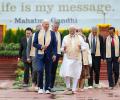
The US hails the landmark 'India-Middle East-Europe Economic Corridor' which will usher in a new era of connectivity from Europe to Asia and will stimulate economic growth across the two continents.
Singh will arrive in Durban on September 30 to participate in the centenary celebrations of Mahatma Gandhi's philosophy of 'Satyagraha' and then for talks with President Thabo Mbeki in Pretoria.
"We should make all efforts for the early finalisation of the Comprehensive Convention on International Terrorism in the United Nations," he said.

Trade between India and China has jumped substantially from $1 billion in 2001 to $52 billion in 2008 and the two sides are targeting to reach $60 billion.

India has not yet received any confirmation on Chinese President Xi Jinping's in-person participation at the upcoming G20 summit, people familiar with the matter said on Thursday amid reports that he is likely skip the conclave.
India will firmly oppose moves by developed countries to impose non-tariff barriers under the garb of promoting clean energy and arresting climate change at the G8 summit in Gleneagles (Scotland).
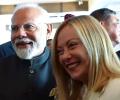
Prime Minister Narendra Modi held a series of bilateral meetings with his global counterparts on the margins of the G7 Summit in Kananaskis, with discussions focusing on a range of issues such as trade, investment, counter-terrorism and global challenges.
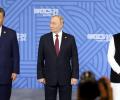
China has expressed its support for Russia's initiative to revive the Russia-India-China (RIC) troika, emphasizing its importance for regional and global security and stability.

Commerce ministers of the three countries, who met in Pretoria on Tuesday, also decided to hold formal annual trilateral talks to boost intra-IBSA trade.
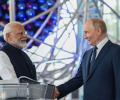
Putin expressed concern over the situation in Gaza, and said Palestinian President Mahmoud Abbas has been invited to BRICS events.
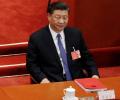
President Xi is also skipping the ASEAN (Association of Southeast Asian Nations) and East Asia summits in Jakarta this week.

Prime Minister Narendra D Modi with Brazil's President Luiz Inacio Lula da Silva, China's President Xi Jinping, South African President Cyril Ramaphosa and Russia's Foreign Minister Sergei Lavrov at the BRICS Summit in Johannesburg, South Africa.

India is awaiting a written confirmation from China on President Xi's participation in the G20 Leaders Summit, Muktesh Pardeshi, Special Secretary for G20, said on Friday.

The G20 leaders will deliberate on pressing global issues at the grouping's annual summit here on September 9 and 10. India is hosting the summit in its capacity as the current G20 chair.

South Africa's Deputy International Relations and Cooperation Minister Marius Fransman said this would give a major boost to some of the development needs of these countries.

The theme of the Summit is "BRICS Partnership for Global Stability, Security and Prosperity". Prime Minister Dr Manmohan Singh will host President Dilma Rousseff of Brazil, President Dimitry Medvedev of Russia, President Hu Jintao of China and President Jacob Zuma of South Africa at the Summit.
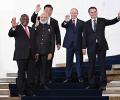
Chinese President Xi Jinping will attend the 13th BRICS summit to be held on Thursday at the invitation of Prime Minister Narendra Modi, China's foreign ministry announced in Beijing on Wednesday.

The summit is being attended by more than 30 heads of state and top officials from the European Union and invited guest countries and 14 heads of international organisations.

"We will examine the latest developments and make a determination about our future engagement with BRICS," Baloch said.
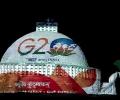
'The group commands 85 per cent of the global GDP, and if you are able to convey your point of view effectively to this group then you have reached more or less all the important players that matter.'

The team of diplomats, including joint secretaries Eenam Gambhir and K Nagraj Naidu, held 300 bilateral meetings and circulated 15 drafts with their counterparts on the contentious Ukraine conflict to drive home a consensus that was clinched on the first day of the G20 Leaders Summit itself.

The meeting will be attended by Russian President Vladimir Putin, Chinese President Xi Jinping, South African President Cyril Ramaphosa and Brazil's Jair Bolsonaro, according to the MEA.
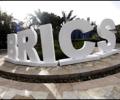
an President Dimitry Medvedev, Chinese President Hu Jintao, Brazil President Dilma Rousseff and South African President Jacob Zuma will participate in the summit hosted by Prime Minister Manmohan Singh.
There is no official word either from China or from India on who will represent Beijing at the upcoming G20 summit.

Without mentioning the boundary dispute, the spokesperson said that China-India relations have been stable on the whole and "our two sides have maintained dialogue and communication at various levels".
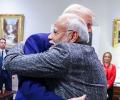
One must wonder whether Mr Modi's efforts to wine and dine the Big Two of today's world were seen as a sign of weakness rather than a proffered arm of friendship, points out R Jagannathan.
 © 2026 Rediff.com - Advertise with us - Disclaimer - Privacy Policy - Sitemap - Feedback - About us - Terms of use - Grievances